Introduction
I finished Commvault SHIFT this year with the same reaction and thought process I had last year — “damn, they’re moving fast”. While most vendors are still talking about ransomware like it’s 2021, Commvault is already engineering the next wave of defence. Not concepts. Not theory. Actual mechanisms to counter real threats hitting organisations — the ones that keep CISOs and CIOs awake at 2 a.m. And they’re doing it before these attacks are even happening!
But let me step back from the announcements for a moment — because there’s a reason I attend Commvault SHIFT every year, and it’s not just for the product reveals and to keep myself up to date with technological advancements in this space (as it is exciting). It’s the mindset. The urgency. The feeling that someone in this industry is treating cyber risk like the living, breathing enemy it is. And that it’s an ongoing cyber war (cue the Star Wars theme) between cybercriminals and do-good companies like Commvault.
Simply put – SHIFT 2025 isn’t just a conference — it’s a call to rethink cyber resilience and a mandate to act on it for organisations and I said this last time at SHIFT, Commvault is no longer just a backup company.
So let’s put that in context – and Sanjay Mirchandani, CEO, Commvault, said it best. “The question we’re addressing today is simple: how fast can you recover in a world where breaches and mistakes are inevitable?” That is, it is not a case of if it will happen, it is a case of when it will happen. Unfortunately, cyber criminals treat it like a job. In order to make ends meet, they need money coming in, and if they believe they can hold an organisation at ransom by accessing their most crucial asset – its data and asking for ransom money, they will do it.
So weaving in data protection, data security and identity protection becomes a mammoth task for all of these teams because lets face it, they are all at risk and no-one is safe..
When Pranay Ahlawat (Chief Technology & AI Officer) and Rajiv Kottomtharayil (Chief Product Officer) then took the main stage, it wasn’t another feature rundown—it was a clear shift in how Commvault sees the future of data security and protection. They didn’t just talk about managing data. They showed how AI can change the way organisations secure it, recover it, and make decisions around it—without drowning in complexity and buzz words.
Now — enough warm-up. Let’s get into the fun stuff, starting with Cloud Unity!

Commvault Cloud Unity and the focus on unified visibility and recovery
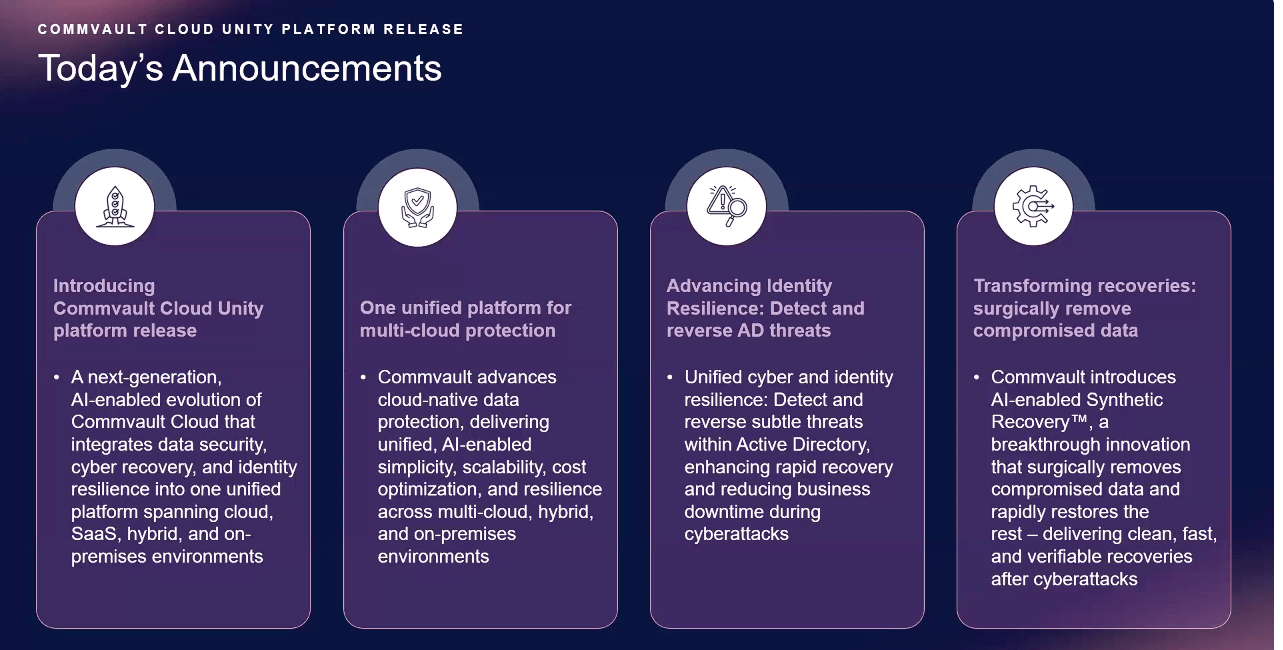
Commvault Cloud Unity eliminates blind spots by unifying visibility and accelerating recovery across all environments — finally giving organisations one place to see, control, and protect everything. Pretty straightforward value sentence, right?
This means Unity delivers organisations a platform where data security, cyber recovery, and identity resilience come together intelligently to provide the visibility and detection platform to tackle threats before they cause damage.
For years, security, identity, and recovery teams have worked in silos—each with their own tools, dashboards, and rules to follow. It wasn’t strategy; it was survival and always reactive. It’s pretty astonishing to realise that these teams are all at risk and now become a unified target for cybercriminals.
And the threat landscape has changed (just look at the stats). Attackers don’t respect those boundaries—so why should the defence? That’s why the Commvault Cloud Unity platform release matters. It finally brings these disciplines together in one place, with one source of truth. Not just unified tech—but unified decisions. Because in modern cyber resilience, fragmentation isn’t just inefficient.
Now, you can monitor, enforce, and respond to threats across an organisation’s entire ecosystem from one place. That means faster response times, cleaner recoveries, and a single version of the truth for all your resilience data-protection, identity and cybersecurity.
Synthetic Recovery in the AI world
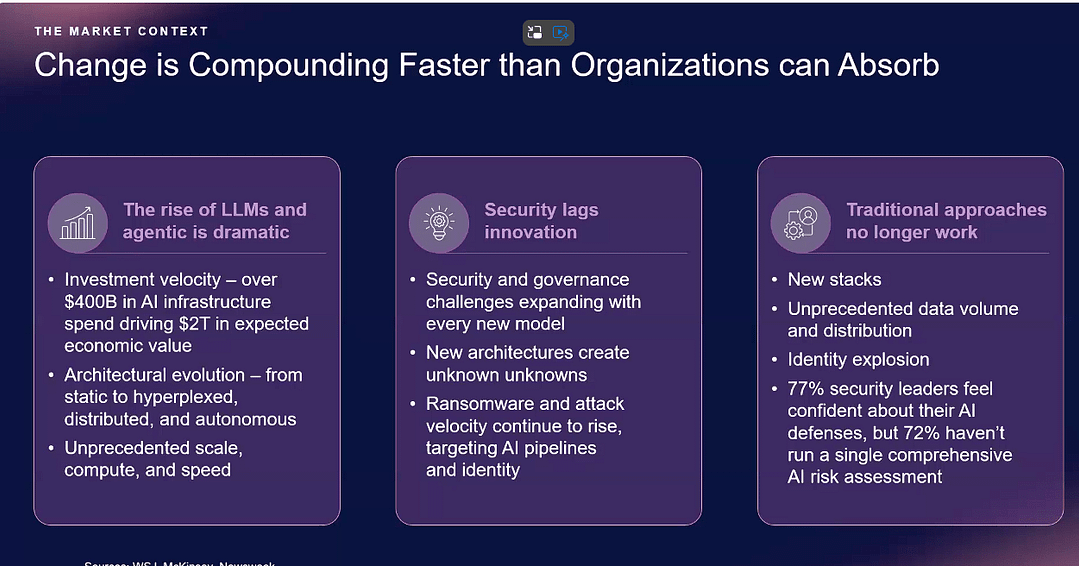
One astonishing data point I learnt from SHIFT was that the investment in AI Infrastructure is picking up pace — fast, $400B in AI infrastructure alone on the back of an unprecedented scale of compute and storage to support. And Commvault are not shying away from AI with their announcements.
What really caught my eye was in the announcements was Synthetic Recovery. Instead of rebuilding everything from scratch after an attack, it selectively removes the compromised data and restores the rest. It does this by automatically pinpointing the cleanest recovery point and rebuilds only the latest uncorrupted data—making restores across your backup estate fast, predictable, and drama-free. (Phew!)
So before the recovery even begins, it filters out encrypted or malicious files to stop reinfection in its tracks and avoid pointless rollbacks. Behind the scenes and to make this happen, an AI-powered multi-engine threat detection ensures only trusted data makes it back into production.


Keeping up with Change — Threat Scan
Leveraging AI to fight AI, pretty cool hey — but that’s the new battleground, and Commvault Threat Scan does just that! Instead of waiting for threats to surface, it proactively inspects your backup data before recovery even starts, identifying malware and suspicious files that could trigger reinfection (especially if restored).
It’s like running a security checkpoint on every restore to remove risk of bad data entering your production. Threat Scan exposes compromised data early, isolates it, and ensures only clean, trusted backups can make their way into production.
The Cloud announcements!
One of the big announcements at SHIFT: Commvault Cloud is now live in both the Microsoft Azure and AWS marketplaces. More importantly, it isn’t just “available.” It’s built to simplify how teams get control of multicloud chaos fast. Here’s what stood out for me:
- Onboarding isn’t manual anymore. The AI platform automatically scans cloud estates, identifies workloads, and suggests protection policies based on what it finds. Less clicking around—more getting protected.
- Clearly Discovered resources are analysed for protection gaps, with reports that show which workloads are covered and which are exposed. It’s the difference between guessing and knowing when things hit the fan.
- After discovery, the platform runs a customer-specific TCO analysis (So in essence, it basically answers the CFO’s question before they ask it. – What good salesperson wouldn’t want this!)
- True Multicloud & Hybrid Support — this isn’t a single-cloud tool—it unifies protection across clouds, regions, and accounts, and even stretches to on-prem data centres and edge locations. All managed from one UI.
- Cyber Resilience Built in — native cloud backups are fine—until they’re not. Commvault Cloud makes it easy to layer in cyber resilience without bolting on another product.
In closing
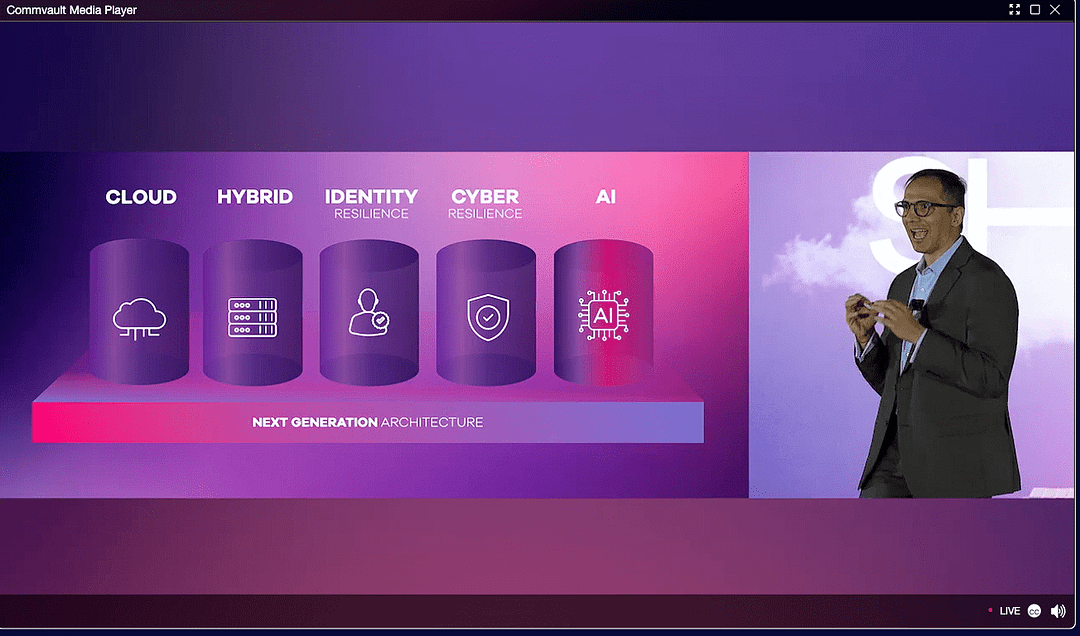
SHIFT is a terrific conference, and it’s amazing how many times any IT practitioner or specialist can walk away just feeling mind blown at the smarts that are happening in Commvault’s development. But again, it’s not just about these announcements, it’s introducing the mindset, the urgency, and how AI is becoming more and more useful in the ongoing battle against AI-charged cybercrime.
Can’t wait for the next one!
For some great headline articles on SHIFT and the announcements:
- Commvault Unveils a New Era in Enterprise Resilience with the Commvault Cloud Unity Platform Release
- https://www.commvault.com/news/new-era-in-enterprise-resilience-commvault-cloud-unity-platform-release
- Commvault Transforms How Enterprises Make Clean, Complete, and Automated Cyber Recoveries –
- https://www.commvault.com/news/transforming-how-enterprises-make-clean-complete-automated-cyber-recoveries
- Commvault Expands End-to-End Identity Resilience: Detect, Log, and Reverse Hard-to-Detect Threats in Active Directory –
- https://www.commvault.com/news/expanding-end-to-end-identity-resilience-detect-log
- Commvault Cloud Unity Platform Release Brings New Levels of Simplicity, Scalability, Cost Optimization, and Resilience for Cloud-First Enterprises –
- https://www.commvault.com/news/shift-2025-cloud-native-data-protection